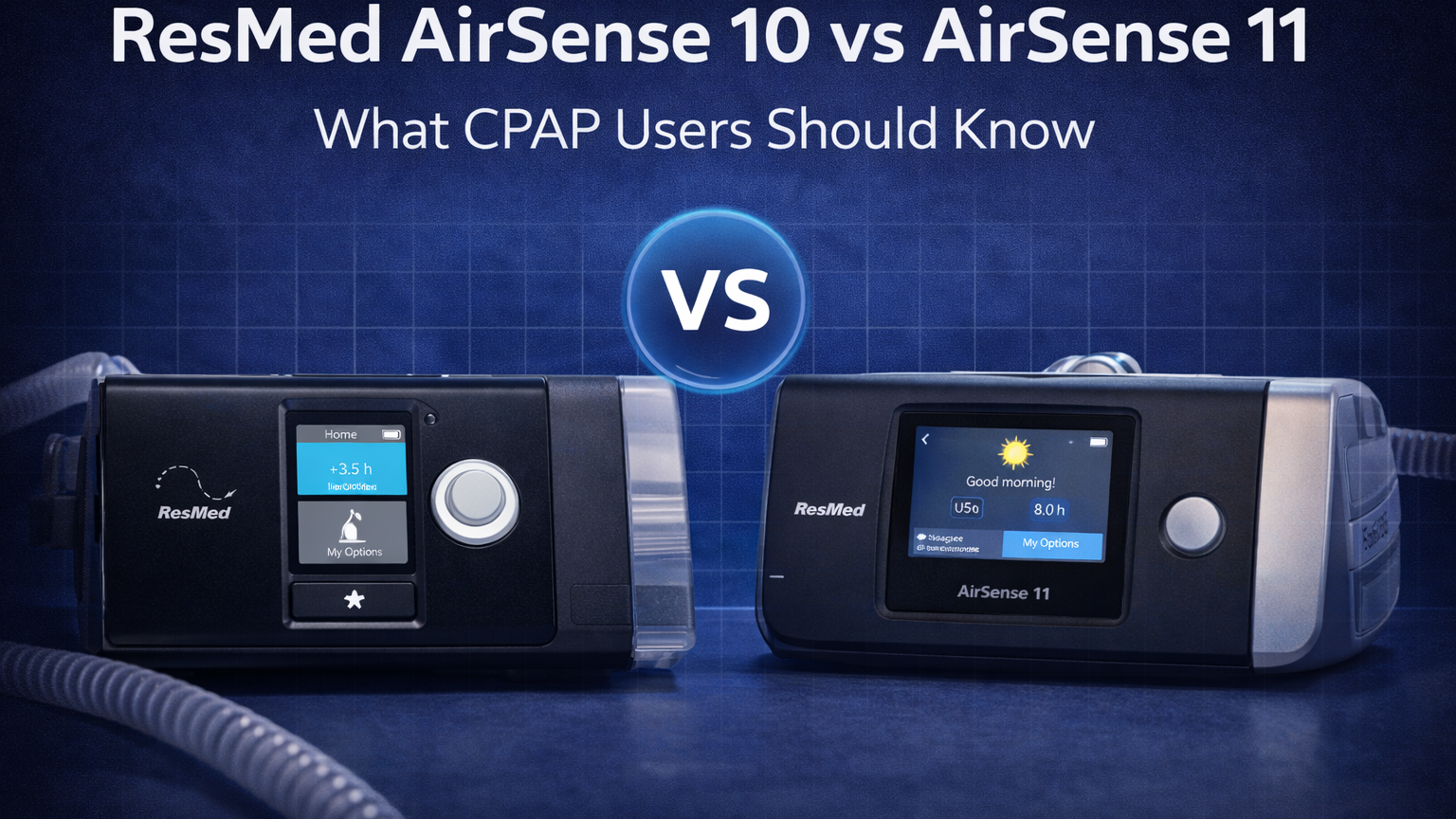
If you are choosing between the ResMed AirSense 10 and the newer AirSense 11, you aren’t just comparing two plastic boxes—you are choosing how you will interact with your life-support therapy every single night.
At first glance, the AirSense 11 appears to be the obvious winner: it’s newer, sleeker, and features a modern touchscreen. But for many CPAP users, the differences that actually matter aren’t found in the marketing brochures. They are found in the data visibility, the nighttime ergonomics, and the reliability of the platform.
This guide focuses on real-world use, not hype. We’ll break down exactly what changes between these two industry titans and how those differences affect your ability to understand and optimize your sleep therapy.
At a Glance: The Core Differences
Before we dive deep, here is a quick comparison of the specs that matter most to users:
FeatureResMed AirSense 10 (AutoSet)ResMed AirSense 11 (AutoSet)
Interface | Physical Dial & Color Screen | Color Touchscreen
Size & Weight | Larger, "Tank-like" build | Sleek, approx. 24% smaller
Algorithm | Proven AutoSet / AutoSet for Her | "For Her" mode included (selectable)
Connectivity | Cellular (some models Card-to-Cloud) | Cellular + Bluetooth (OTA updates)
Data Access | SD Card + On-Screen Menu | SD Card + myAir App focus
Power Supply | 90W Proprietary | 65W Proprietary (Different connector)
1. Therapy Performance: Same Engine, New Body?
From a strictly clinical standpoint, the two devices are fundamentally similar. Both machines utilize ResMed’s proprietary AutoSet algorithm, which is widely regarded as the gold standard for Auto-CPAP (APAP) therapy.
Both devices track core metrics, including:
- AHI (Apnea-Hypopnea Index)
- Leak Rate
- Pressure delivery
- Flow limitations
The Verdict: Whether you buy the 10 or the 11, you are getting the same high-quality pneumatic performance. If your goal is simply "effective pressure," both machines deliver. The difference lies in the experience, not the air.
2. Interface & Usability: Buttons vs. Touchscreens
This is the most polarizing difference between the two generations.
The AirSense 10: The Tactical Choice
The AirSense 10 features a physical dial and a "Home" button.
- Pros: You can operate it by feel in the pitch black. It is less prone to accidental inputs, and the screen doesn't need to be touched (meaning no fingerprints).
- Cons: It feels "older." Navigating deep clinical menus requires a lot of twisting and clicking.
The AirSense 11: The Modern Choice
The AirSense 11 moves to a smartphone-style touchscreen.
- Pros: Intuitive for anyone who uses a phone. The menus are cleaner, and the "For Her" algorithm is now a software toggle rather than a separate machine purchase.
- Cons: Touchscreens can be tricky if your fingers are sweaty or if you are groggy. More importantly, you have to look at the screen to interact with it, which can be jarring in a dark room.
User Insight: Many long-time CPAP users prefer the AirSense 10’s dial because it offers tactile feedback. However, new users tend to find the AirSense 11’s "Personal Therapy Assistant" and guided onboarding less intimidating.
3. The Data Dilemma: What They Don't Show You
This is the most critical section for anyone who wants to actually optimize their sleep, rather than just endure it.
ResMed pushes users toward the myAir app. On the AirSense 11, this integration is tighter via Bluetooth. The app gives you a "Score" out of 100.
The Problem with the Score:
A score of "95/100" looks great, but it can hide serious issues. You might have a high score but still feel tired because of:
- Micro-arousals (RERAs) that don't trigger a full apnea event.
- Flow limitations that restrict breathing but don't stop it.
- Mask leaks that occur only during deep REM sleep.
Neither the AirSense 10 nor the 11 displays detailed breathing waveforms on their screens. To see the truth behind your sleep, you need to access the data stored on the SD Card.
The Shift to Cloud vs. Local Data
- AirSense 10: Often preferred by "data power users" because it has a robust history of compatibility with third-party desktop software.
- AirSense 11: Designed for the cloud. While it still has an SD slot, the device aggressively pushes you toward the simplified app data.
The Solution:
You shouldn't need a medical degree to understand why you woke up tired. Whether you use the 10 or the 11, the raw data on your SD card holds the answer. This is where modern AI tools bridge the gap.
4. Hardware & Design Considerations
- Size: The AirSense 11 is lighter and smaller, making it slightly better for travel (though it still requires a dedicated power brick).
- Humidification: Both use heated humidifiers. However, the AirSense 11 water tub is flat bottomed, whereas the AirSense 10 tub opens like a clamshell. Some users find the 10 easier to clean.
- The "Card-to-Cloud" Factor: Due to chip shortages, many new AirSense 10 units are sold as "Card-to-Cloud," meaning they have no cellular modem. If you buy one of these, the only way to see your data is via the SD card.
Conclusion: Which One Should You Buy?
Stick with (or Buy) the AirSense 10 If:
- You prefer physical buttons and tactile control.
- You want a machine with a proven, decade-long track record of reliability.
- You are budget-conscious (the AirSense 10 is often significantly cheaper).
Upgrade to the AirSense 11 If:
- You want the latest technology and "future-proofing" (Over-the-Air software updates).
- You appreciate a modern, guided setup experience.
- You want the "For Her" algorithm without buying a specific pink/white machine.
The Bottom Line: Data is King
Regardless of which machine you choose, the machine is only half the battle. The other half is understanding the therapy. A machine that blows air is good; a machine that provides insight is life-changing.
Don't settle for a generic "Sleep Score." Unlock the full potential of your AirSense 10 or 11 by analyzing the deeper metrics hidden on your device.
Want to see your CPAP data clearly?
SleepLink uses AI to visualize and explain your therapy data, helping you spot trends and improve comfort without the guesswork.
👉 Start your journey to better sleep insights with SleepLink