
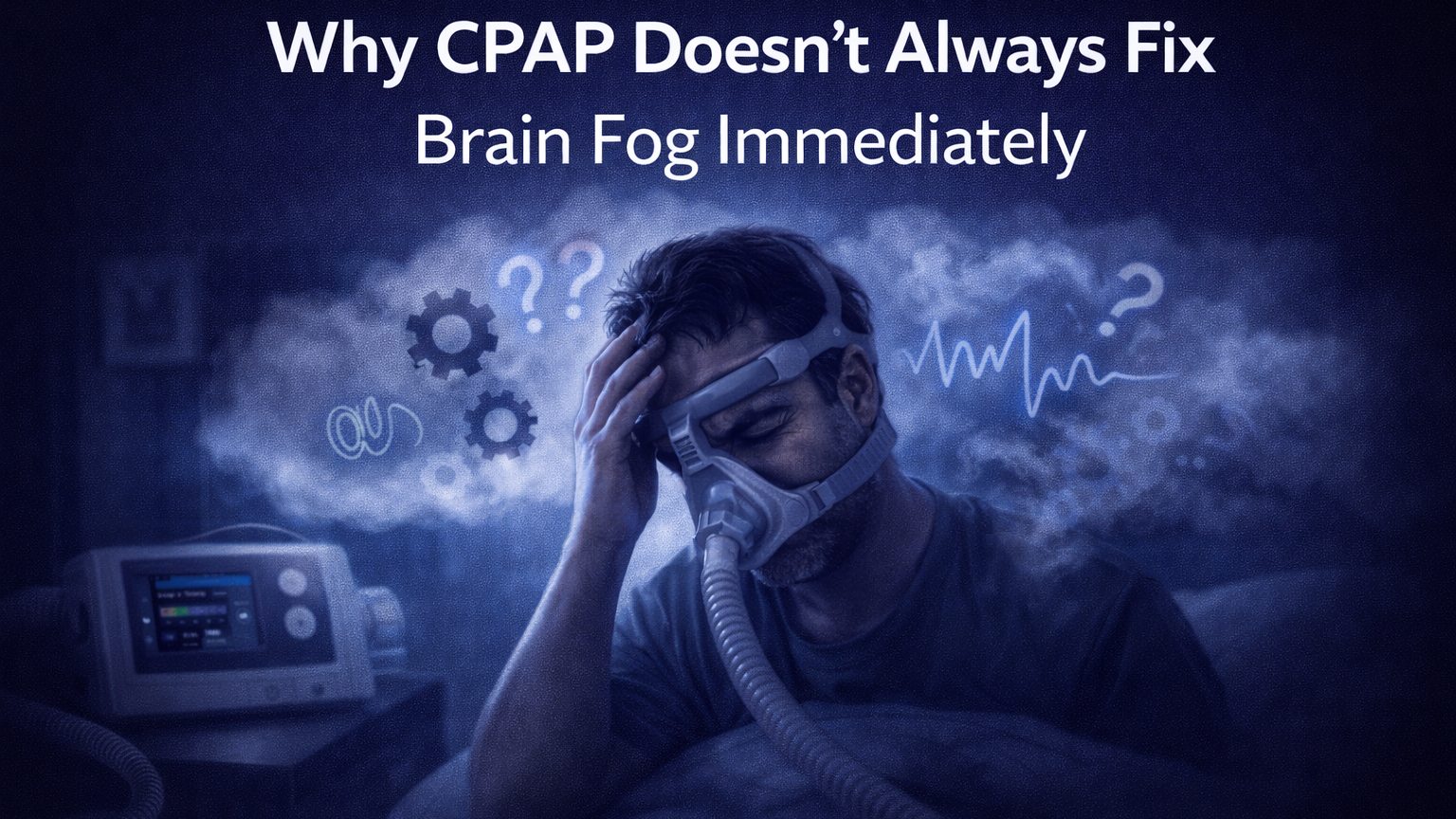
Many people start CPAP therapy with a clear expectation:
Once I’m treated, my brain fog will disappear.
So when weeks—or even months—pass and mental clarity still feels out of reach, frustration quickly sets in. This experience is far more common than most CPAP users expect, and it does not automatically mean that therapy isn’t working.
Brain fog is influenced by more than the presence or absence of apneas. CPAP is a powerful tool, but recovery of cognitive sharpness often takes time—and depends on factors that go beyond a single metric.
What People Mean by “Brain Fog”
Brain fog isn’t a medical diagnosis. It’s a collection of symptoms people commonly describe as:
- Slower thinking
- Difficulty concentrating
- Memory lapses
- Reduced mental stamina
For many with sleep-disordered breathing, these symptoms build gradually over time—often long before CPAP begins.
CPAP Fixes Breathing First - Not Everything at Once
CPAP’s primary role is to support breathing during sleep. When therapy begins:
- Apneas and hypopneas often decrease quickly
- Oxygen stability usually improves
- Sleep becomes physiologically safer
But cognitive recovery follows a different timeline.
The brain needs consistent, stable sleep over time to restore attention, memory, and processing speed.
Reason 1: Sleep Fragmentation Can Persist
Even with a low AHI, sleep may still be fragmented by:
- Subtle breathing disturbances
- Flow limitation
- Micro-arousals you don’t remember
These interruptions can prevent the brain from spending enough uninterrupted time in deep and REM sleep—both critical for mental clarity.
Reason 2: Recovery Is Cumulative, Not Instant
Brain fog often reflects long-term sleep disruption, not just last night’s sleep.
Think of it like sleep debt:
- CPAP stops adding new debt
- But existing debt takes time to repay
Many users notice gradual improvement rather than an overnight change.
Reason 3: Night-to-Night Variability Matters
Early CPAP therapy often includes:
- Inconsistent sleep quality
- Adjustment periods
- Mask comfort issues
Some nights support recovery better than others. Mental clarity tends to improve as sleep becomes more stable and predictable across weeks.
Reason 4: The Brain Needs Time to Relearn Restful Sleep
After months or years of disrupted sleep, the nervous system can remain in a semi-alert state—even when breathing improves.
Over time, consistent calm nights help:
- Reduce hyperarousal
- Normalize sleep depth
- Improve cognitive resilience
This process isn’t linear—and setbacks are normal.
Why AHI Alone Doesn’t Explain Brain Fog
AHI measures event frequency—not sleep quality.
You can have:
- AHI below 2
- Good compliance
- Few obvious events
…and still experience lingering cognitive symptoms if sleep continuity and breathing smoothness haven’t fully stabilized.
Signs Brain Fog Is Improving (Even If Slowly)
Progress often shows up subtly:
- Better focus earlier in the day
- Fewer afternoon crashes
- Improved word recall
- More mental endurance
These changes tend to appear before full clarity returns.
When Patience—and Insight—Help Most
Understanding your sleep patterns can reduce frustration during this phase.
Looking at:
- Trends over weeks
- Breathing stability
- Night-to-night consistency
can help you see progress that isn’t obvious day to day.
SleepLink helps CPAP users interpret these patterns—so recovery feels guided rather than uncertain.
The Takeaway
CPAP often improves breathing quickly - but brain fog usually clears gradually.
That delay doesn’t mean failure. It reflects how deeply sleep disruption affects the brain—and how much consistent rest it takes to recover.
Clarity tends to return not all at once, but in layers.
Looking for Clarity Beyond the Numbers?
👉 Visit https://sleeplink.app to better understand your sleep patterns and recovery over time—beyond a single metric.